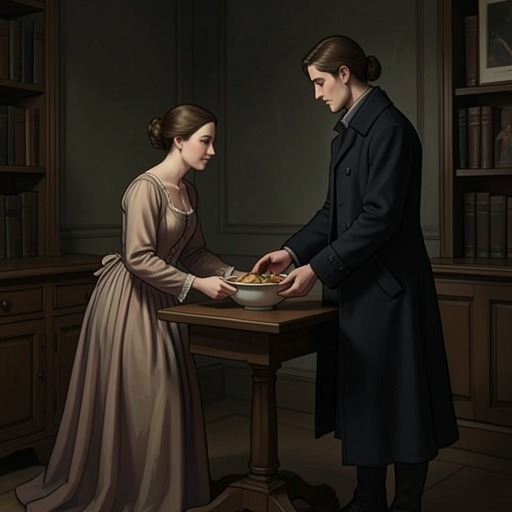
The sea woman tends Marie-Josèphe’s wound
The Moon and the SunThe sea woman tends Marie-Josèphe’s wound at a moment when their fragile connection is tested by pain and misunderstanding. The sea woman’s response makes her concern legible without ordinary speech, while Lucien de Barenton, Count de Chrétien, must take over the practical treatment. The scene moves from song and touch to human medicine, but leaves the bond between the two women at its center.
Context and Communication
Marie-Josèphe is feverishly distracted, and the sea woman’s whispered song deepens her loneliness and despair. Marie-Josèphe puts her hand into the water, hoping its coolness will soothe her; the ripples from her movement meet the wake left by the sea woman. For a moment, the two patterns intersect and hold her attention. This brief physical exchange precedes the sea woman’s direct response to the injury.
The sea woman takes Marie-Josèphe’s swollen hand. Marie-Josèphe asks her to let go because the touch hurts, but the sea woman does not release her. Instead, she follows the purple streaks on the palm, pushes back the sleeve of Marie-Josèphe’s hunting habit, and loosens the wet bandage. The action begins in pain and apparent refusal, yet the sea woman’s attention to the wound and her worried humming make clear that she is trying to help, not simply restrain Marie-Josèphe.
The Sea Woman’s Intervention
As she examines the exposed wound, the sea woman changes the key of her humming from worry to reassurance. She works at the bandage with her long, webbed fingers, then tends the incision directly. The contact causes the wound to bleed again, and Marie-Josèphe feels sick. The episode does not present the sea woman’s method as effective medical treatment; its significance lies in the deliberate attention behind it, and in the risk that care can be misread when the two women lack a shared spoken language.
The sea woman’s urgency has a stated cause. She fears that if Marie-Josèphe dies of her wounds, she will be left without an ally to help her escape. That fear joins concern for Marie-Josèphe’s survival to the sea woman’s own confinement and need for assistance. Her humming, touch, and persistence carry what she cannot explain in words. When Lucien enters, the sea woman releases Marie-Josèphe and submerges herself in the pool. Marie-Josèphe cannot tell him what the sea woman intended; the care has been physically unmistakable but remains verbally unexplained.
Lucien’s Treatment
Lucien lets the wound bleed while Marie-Josèphe asks him to stop it. He reassures her and prepares lint, a bandage, and spirits of wine from his saddlebag. He warns her that the treatment will hurt, then pours the spirits over the wound and presses lint against it. Though he fears the wound may be dangerous, Marie-Josèphe neither cries out nor flinches during this treatment.
Lucien then takes out a small silver casket containing the remaining M. de Baatz' salve. He has already used most of it on wounds belonging to Chartres and himself, and has not returned to Brittany to replenish his supply. He spreads the thick black salve over Marie-Josèphe’s wound and uses all that remains, dresses the wound, and bandages it. He hopes the swelling has already diminished and tells her she should recover in a day or two, but his confidence is not complete: he fears gangrene even after applying the salve. His intervention offers a more deliberate course of treatment, not a guaranteed cure.
Care, Trust, and Uncertainty
The episode places two kinds of help beside each other without making them equivalent. The sea woman notices the wound, responds with alarm, and attempts to tend it through touch and humming; Lucien uses supplies and a practiced sequence of treatment. The first response communicates attachment but aggravates the bleeding, while the second is medically directed yet shadowed by the possibility that the injury will worsen. Neither care removes uncertainty.
After Lucien finishes, Marie-Josèphe lays her unwounded hand over his and thanks him, recalling how often he has rescued her. Her gesture makes visible a trust already established between them. The sea woman’s intervention complicates that moment: she too has acted to preserve Marie-Josèphe, though her reason includes the loss of an ally and her methods cannot be explained. The scene therefore makes care a form of communication as well as an action. It shows the sea woman’s fear of isolation, Marie-Josèphe’s dependence on human assistance, and the limits faced by all three when pain, danger, and unspoken intentions meet.